




Introduction: The Unseen Data Stream
In the world of web performance and Search Engine Optimization (SEO), server log files are often the most overlooked yet critical source of truth. They record every single interaction between a server and a client—whether it’s a human user or a search engine crawler. Neglecting this data is akin to running a business without reviewing its financial statements.
This educational case study utilizes real, anonymized log data from a high-traffic website to demonstrate the risks of ignoring server logs and provides a clear framework for proactive monitoring.
The Case: A High-Traffic Website’s Hidden Bleed
We analyzed over half a million requests to a major web property over a specific period. The initial findings, hidden within the raw data, revealed a significant performance hemorrhage silently undermining the site’s stability and SEO efforts.
Finding 1: The Critical 4xx Error Rate
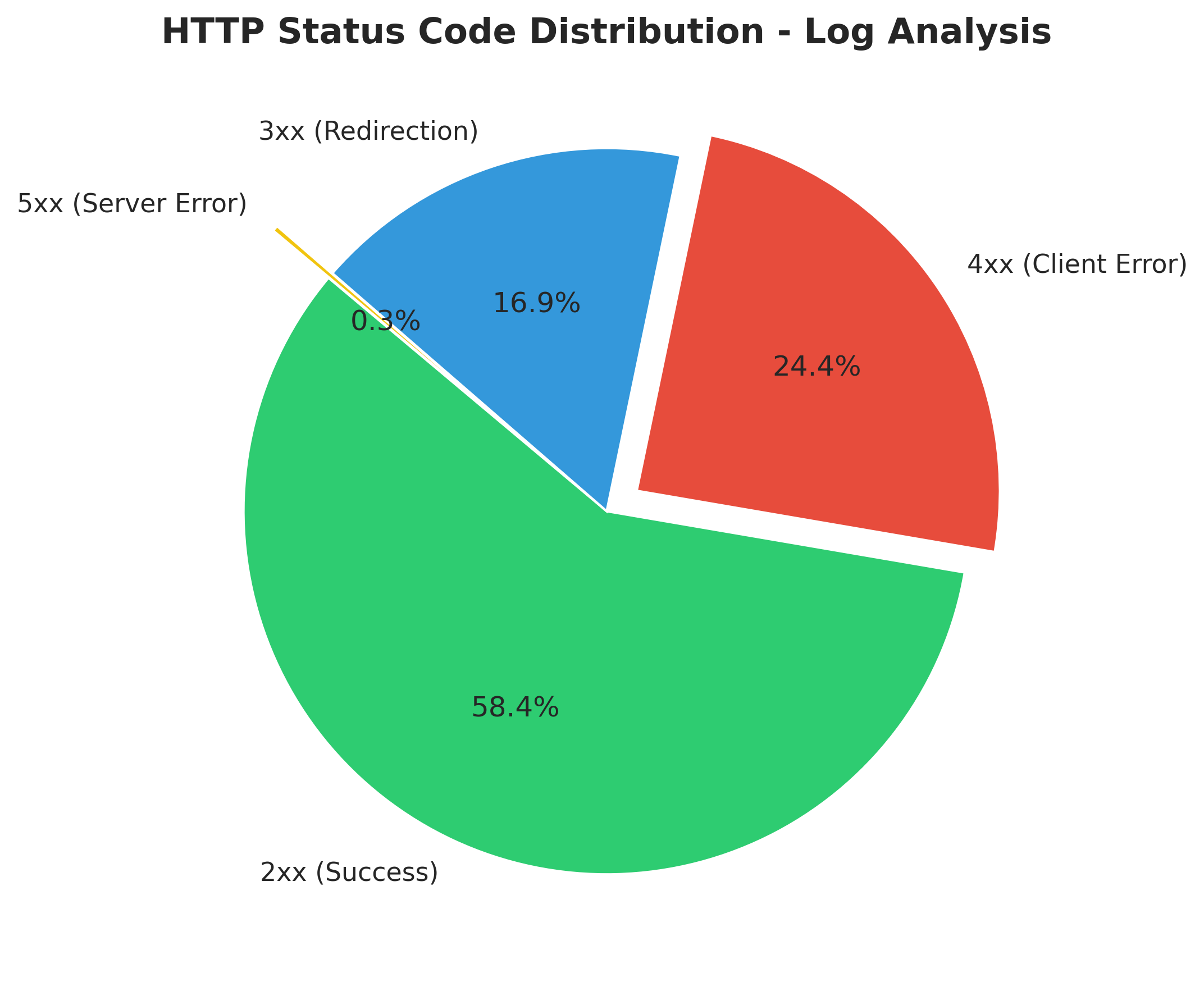
The most alarming discovery was the distribution of HTTP status codes. While successful requests (2xx) dominated, the volume of Client Errors (4xx) was exceptionally high.
| Status Code | Description | Count | Percentage |
|---|---|---|---|
| 2xx | Success | 310,209 | 58.41% |
| 4xx | Client Error (Broken Links) | 129,784 | 24.44% |
| 3xx | Redirection | 89,671 | 16.89% |
| 5xx | Server Error (Instability) | 1,396 | 0.26% |
| Total | 531,060 | 100% |
Key Insight:
A staggering 24.44% of all requests resulted in a 4xx error (e.g., 404 Not Found). This means nearly one in four interactions with the server ended in a dead end.
This is visually represented in the status code distribution chart.
This is visually represented in the status code distribution chart:
Finding 2: The Threat of Server Instability
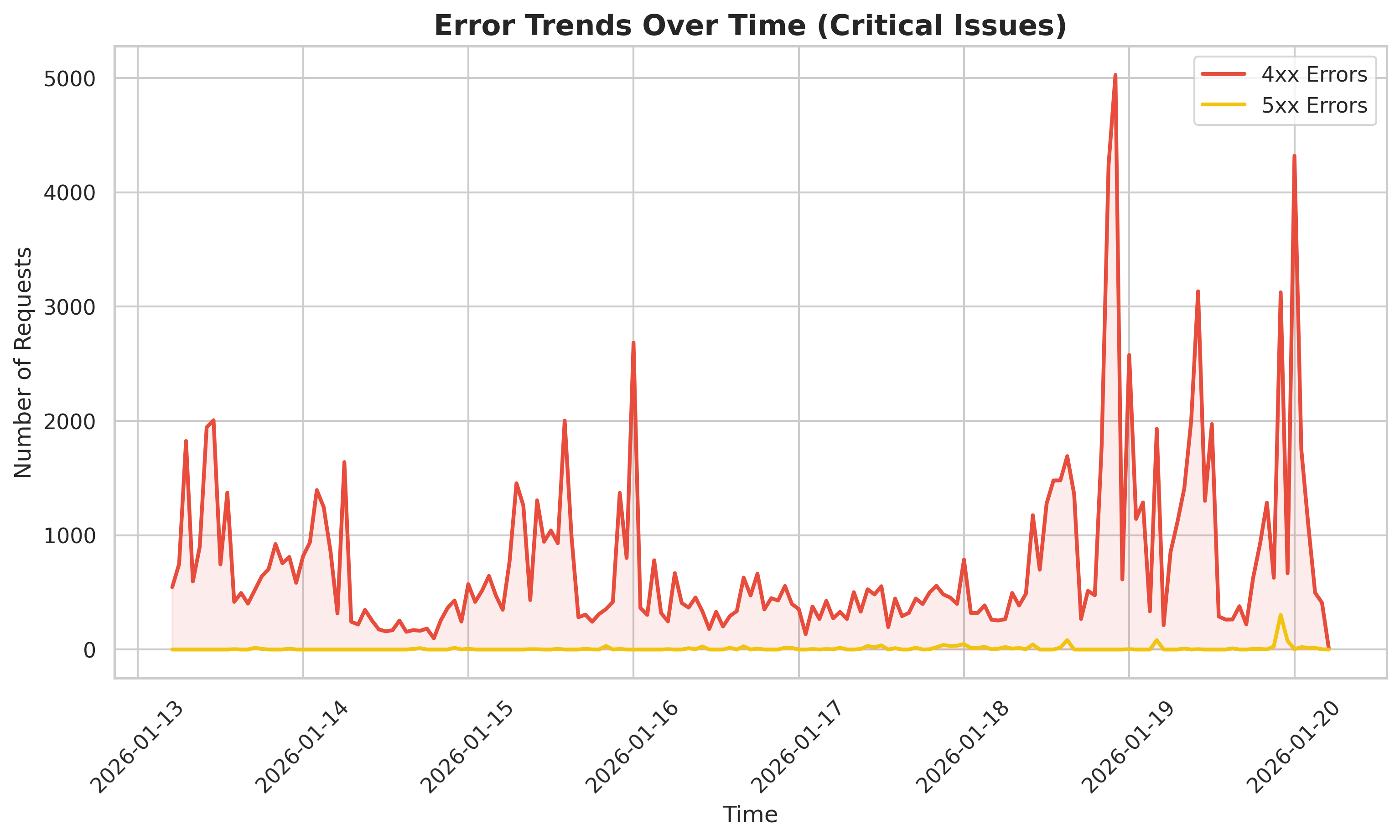
Although the 5xx Server Error rate was low (0.26%), the presence of 1,396 server-side failures indicates underlying instability. These errors are the most damaging because they signal that the server itself failed to fulfill a valid request, potentially causing:
-
Service outages
-
Severe SEO ranking drops if persistent
Risk Analysis: Why These Errors Matter
1. Severe Crawl Budget Waste
Search engines allocate a limited Crawl Budget to each website, dictating how many pages a crawler (like Googlebot) can process in a given timeframe.
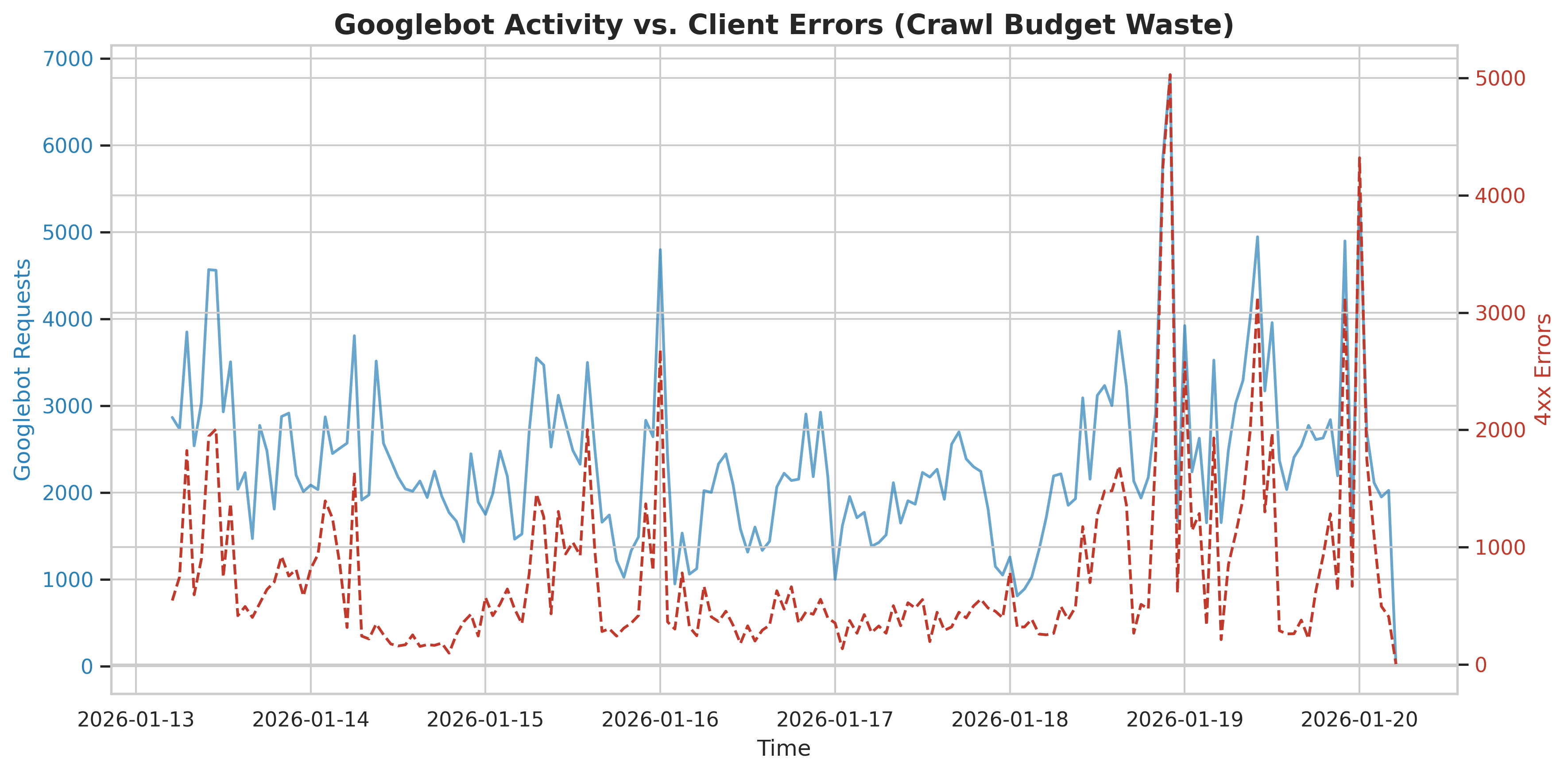
In this case study, Googlebot made 399,880 requests. When 24.44% of those requests result in 4xx errors:
-
The search engine wastes valuable time on broken pages.
-
Important new content is indexed slowly.
-
Repeated visits to dead links reduce organic visibility.
The chart below illustrates the correlation between Googlebot activity and 4xx errors, highlighting the wasted crawl budget.
2. Deterioration of User Experience
-
High volume of 404 pages frustrates users → increased bounce rates.
-
Even infrequent 5xx errors can cause complete service interruptions → users turn to competitors.
-
Negative impact on brand perception and reliability.
Prevention and Mitigation: An Actionable Roadmap
Log analysis is not just about finding problems—it’s about creating a proactive maintenance strategy. Based on the findings, here’s a roadmap:
Step 1: Prioritize 4xx Resolution
Focus immediately on eliminating 4xx errors that waste crawl budget.
-
Action: Identify the top 50 URLs generating 4xx errors.
-
Pages that have moved → implement 301 Permanent Redirect.
-
Pages deleted → return 410 Gone or update internal links.
-
-
Tooling: Use log analysis tools to filter and sort requests by status code and frequency.
Step 2: Establish 5xx Monitoring and Root Cause Analysis
Server errors indicate system failure and require immediate attention.
-
Action: Set up real-time alerts for any 5xx errors.
-
Cross-reference error timestamps with server resource logs (CPU, memory, database query times).
-
Common causes: database bottlenecks, application memory leaks.
-
Step 3: Optimize Crawl Budget
Ensure search engines focus on high-value content.
-
Action: Review
robots.txt.-
Use Disallow for low-value pages (admin areas, filtered search results, internal scripts).
-
Direct crawlers to pages that truly matter.
-
Step 4: Continuous Monitoring
-
Log analysis should be continuous, not one-off.
-
Conduct weekly or monthly reviews to catch new errors before they escalate.
Conclusion
This case study shows that even successful, high-traffic websites can suffer from hidden performance issues.
-
24.44% 4xx error rate → wasted crawl budget, poor user experience, SEO loss.
-
5xx errors, even if low, → server instability, potential outages.
Takeaway: Integrating log analysis into regular maintenance transforms SEO and performance management from reactive firefighting to proactive, data-driven optimization, ensuring long-term growth and health of digital assets.